
Neptuniaoleracea (water mimosa) as phytoremediation plant and the risk to human health: A review
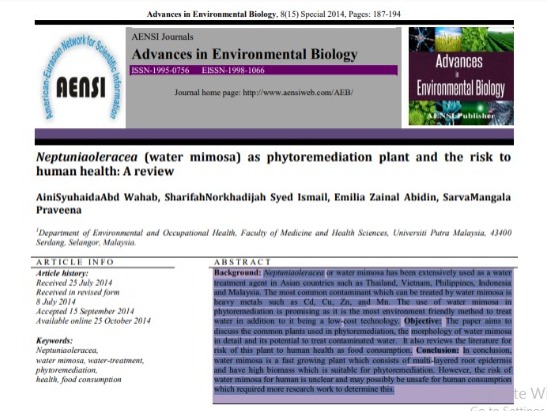
Neptuniaoleracea or water mimosa has been extensively used as a water treatment agent in Asian countries such as Thailand, Vietnam, Philippines, Indonesia and Malaysia. The most common contaminant which can be treated by water mimosa is heavy metals such as Cd, Cu, Zn, and Mn. The use of water mimosa in phytoremediation is promising as it is the most environment friendly method to treat water in addition to it being a low-cost technology. Objective: The paper aims to discuss the common plants used in phytoremediation, the morphology of water mimosa in detail and its potential to treat contaminated water. It also reviews the literature for risk of this plant to human health as food consumption. Conclusion: In conclusion, water mimosa is a fast growing plant which consists of multi-layered root epidermis and have high biomass which is suitable for phytoremediation. However, the risk of water mimosa for human is unclear and may possibly be unsafe for human consumption which required more research work to determine this.
Authors
Abstract
Neptuniaoleracea or water mimosa has been extensively used as a water treatment agent in Asian countries such as Thailand, Vietnam, Philippines, Indonesia and Malaysia. The most common contaminant which can be treated by water mimosa is heavy metals such as Cd, Cu, Zn, and Mn. The use of water mimosa in phytoremediation is promising as it is the most environment friendly method to treat water in addition to it being a low-cost technology. Objective: The paper aims to discuss the common plants used in phytoremediation, the morphology of water mimosa in detail and its potential to treat contaminated water. It also reviews the literature for risk of this plant to human health as food consumption. Conclusion: In conclusion, water mimosa is a fast growing plant which consists of multi-layered root epidermis and have high biomass which is suitable for phytoremediation. However, the risk of water mimosa for human is unclear and may possibly be unsafe for human consumption which required more research work to determine this.
Citation
APA: AiniSyuhaida, A., W., SharifahNorkhadijah, S., I., Emilia, Z., A., SarvaMangala, P. Neptuniaoleracea (water mimosa) as phytoremediation plant and the risk to human health: A reviewAdv. Environ. Biol., 8(15), 187-194, 2014