
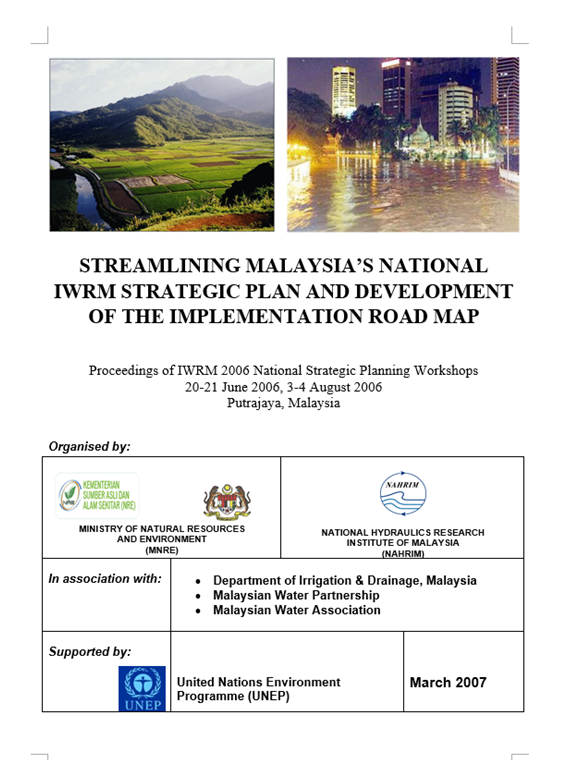
Streamlining Malaysia's National IWRM Strategic Plan and Development of the Implementation Road Map
“IWRM or Integrated Water Resources Management” can have many definitions but the most commonly used definition by GWP (Global Water Partnership) is “A process which promotes the coordinated development and management of water, land and related resources, in order to maximise the resultant economic and social welfare in an equitable manner without compromising the sustainability of vital ecosystems” The IWRM concept was first introduced in Malaysia in various forms in the early 1990s by water technical agencies such as the Department of Irrigation and Drainage. In principle, Malaysia has since accepted and adopted the concept of IWRM in its overall economic development. This is embodied in the country’s Vision 2020 (1990-2020) when it was stated that “….Malaysia will be a developed nation by 2020, with the environment remaining pristine….”. Thus, recognising the importance of water management the government in March 2004 reorganized its ministries and set up 2 new key ministries dealing with water. They are the Ministry of Natural Resources and Environment (MNRE) to look after water resources management; and the Ministry of Energy, Water and Communication (MEWC) to look after the water services requirements, including domestic and industrial water supply, sewerage and hydro power. There is a need to plan and provide for a balance development between natural resources exploration and conservation, to come out with priority actions and to develop awareness on the importance of natural resources and environmental conservation to the public. Water Resources and Land are the 2 major natural resources under the MNRE. Each depends on the other and each has impacted on each other. Both are key factors in the country’s continued sustainable economic development. Of late issues pertaining to water and water resources such as water shortages, deterioration of water quality, floods, landslide, river and coastal erosions and forest fires have escalated and have gained prominence. It is therefore within the MNRE’s role and responsibilities to look at possible alternatives in dealing with the above issues which can cause catastrophic damages not only to the economy but the lives and livelihood of our people. There is a need to look at the issues in a holistic and integrated manner, to call for innovative ideas and to consult all stakeholders on how to manage a resource that is so central to our existence IWRM 2005 SEA At the World Summit on Sustainable Development (WSSD), Johannesburg 26 August to 4 September 2002, Malaysia was represented by YAB Datuk Abdullah Ahmad Badawi. Malaysia was a signatory to the WSSD Declaration in which all signatories agreed to prepare Integrated Water Resources Management (IWRM) Strategic Plan by 2005, hence the name IWRM 2005. In support of the WSSD objective for IWRM2005 the United Nations Environment Programme (UNEP) has implemented a project in 2005/2006 to support South East Asian countries to achieve their IWRM 2005 commitment to the WSSD. The UNEP project is known as IWRM 2005 SEA and was implemented through a UNEP implementation agency UCC-Waters. As part of the project UNEP has provided a small grant to Malaysia to assist it in streamlining its IWRM strategy and to prepare a road map for its implementation.
Authors
Abstract
“IWRM or Integrated Water Resources Management” can have many definitions but the most commonly used definition by GWP (Global Water Partnership) is “A process which promotes the coordinated development and management of water, land and related resources, in order to maximise the resultant economic and social welfare in an equitable manner without compromising the sustainability of vital ecosystems” The IWRM concept was first introduced in Malaysia in various forms in the early 1990s by water technical agencies such as the Department of Irrigation and Drainage. In principle, Malaysia has since accepted and adopted the concept of IWRM in its overall economic development. This is embodied in the country’s Vision 2020 (1990-2020) when it was stated that “….Malaysia will be a developed nation by 2020, with the environment remaining pristine….”. Thus, recognising the importance of water management the government in March 2004 reorganized its ministries and set up 2 new key ministries dealing with water. They are the Ministry of Natural Resources and Environment (MNRE) to look after water resources management; and the Ministry of Energy, Water and Communication (MEWC) to look after the water services requirements, including domestic and industrial water supply, sewerage and hydro power. There is a need to plan and provide for a balance development between natural resources exploration and conservation, to come out with priority actions and to develop awareness on the importance of natural resources and environmental conservation to the public. Water Resources and Land are the 2 major natural resources under the MNRE. Each depends on the other and each has impacted on each other. Both are key factors in the country’s continued sustainable economic development. Of late issues pertaining to water and water resources such as water shortages, deterioration of water quality, floods, landslide, river and coastal erosions and forest fires have escalated and have gained prominence. It is therefore within the MNRE’s role and responsibilities to look at possible alternatives in dealing with the above issues which can cause catastrophic damages not only to the economy but the lives and livelihood of our people. There is a need to look at the issues in a holistic and integrated manner, to call for innovative ideas and to consult all stakeholders on how to manage a resource that is so central to our existence IWRM 2005 SEA At the World Summit on Sustainable Development (WSSD), Johannesburg 26 August to 4 September 2002, Malaysia was represented by YAB Datuk Abdullah Ahmad Badawi. Malaysia was a signatory to the WSSD Declaration in which all signatories agreed to prepare Integrated Water Resources Management (IWRM) Strategic Plan by 2005, hence the name IWRM 2005. In support of the WSSD objective for IWRM2005 the United Nations Environment Programme (UNEP) has implemented a project in 2005/2006 to support South East Asian countries to achieve their IWRM 2005 commitment to the WSSD. The UNEP project is known as IWRM 2005 SEA and was implemented through a UNEP implementation agency UCC-Waters. As part of the project UNEP has provided a small grant to Malaysia to assist it in streamlining its IWRM strategy and to prepare a road map for its implementation.
Citation
IR. LIEW YUK SAN . 2020. Streamlining Malaysia's National IWRM Strategic Plan and Development of the Implementation Road Map. Digital NAHRIM Publication Repository.