
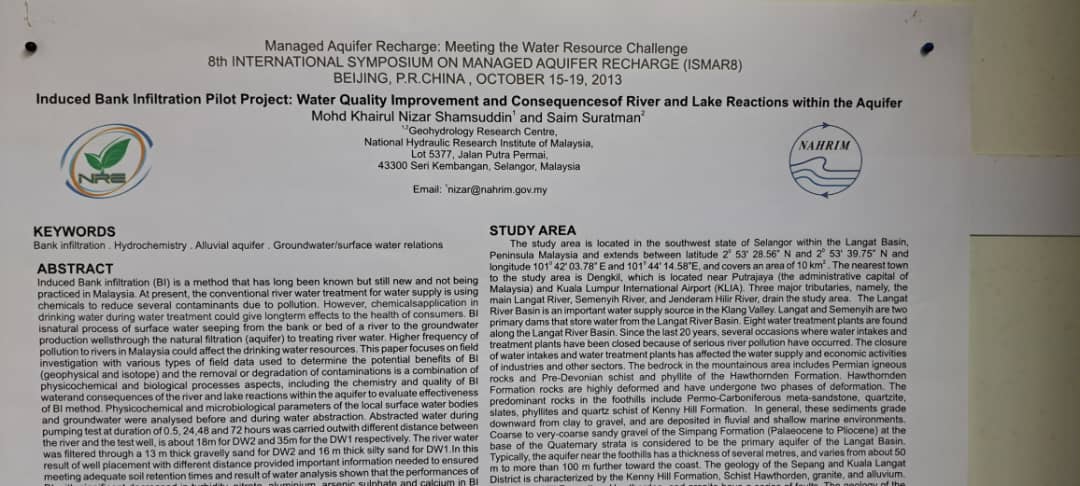
induced bank infiltration pilot project: water quality improvement and consequences of river and lake reactions within aquifer
Induced Bank infiltration (BI) is a method that has long been known but still new and not being practiced in Malaysia. At present, the conventional river water treatment for water supply is using chemicals to reduce several contaminants due to pollution. BI isnatural process of surface water seeping from the bank or bed of a river to the groundwater production wellsthrough the natural filtration (aquifer) to treating river water. Higher frequency of pollution to rivers in Malaysia could affect the drinking water resources. This paper focuses on field investigation with various types of field data used to determine the potential benefits of BI (geophysical and isotope) and the removal or degradation of contaminations is a combination of physicochemical and biological processes aspects, including the chemistry and quality of BI waterand consequences of the river and lake reactions within the aquifer to evaluate effectiveness of BI method. Physicochemical and microbiological parameters of the local surface water bodies and groundwater were analysed before and during water abstraction. Abstracted water during pumping test at duration of 0.5, 24,48 and 72 hours was carried outwith different distance between the river and the test well, is about 18m for DW2 and 35m for the DW1 respectively. The river water was filtered through a 13 m thick gravelly sand for DW2 and 16 m thick silty sand for DW1.In this result of well placement with different distance provided important information needed to ensured meeting adequate soil retention times and result of water analysis shown that the performances of BI with significant decreased in turbidity, nitrate, aluminium, arsenic sulphate and calcium in BI which were very high in the river. Microorganism counting (E. coli, total coliform, Cryptosporidium and Giardia) confirmed that the microorganism counts were significantly reduced during the passage in BI which is capable to achieve more than 99.9 % removal of E. coli, total coliform and Giardia.It is shown that, there are very much interest on the effectiveness of BI method for the sustainability of water management in the Langat Basin due to the high water demand in the area However, chemicalsapplication in drinking water during water treatment could give longterm effects to the health of consumers.
Authors
Abstract
Induced Bank infiltration (BI) is a method that has long been known but still new and not being practiced in Malaysia. At present, the conventional river water treatment for water supply is using chemicals to reduce several contaminants due to pollution. BI isnatural process of surface water seeping from the bank or bed of a river to the groundwater production wellsthrough the natural filtration (aquifer) to treating river water. Higher frequency of pollution to rivers in Malaysia could affect the drinking water resources. This paper focuses on field investigation with various types of field data used to determine the potential benefits of BI (geophysical and isotope) and the removal or degradation of contaminations is a combination of physicochemical and biological processes aspects, including the chemistry and quality of BI waterand consequences of the river and lake reactions within the aquifer to evaluate effectiveness of BI method. Physicochemical and microbiological parameters of the local surface water bodies and groundwater were analysed before and during water abstraction. Abstracted water during pumping test at duration of 0.5, 24,48 and 72 hours was carried outwith different distance between the river and the test well, is about 18m for DW2 and 35m for the DW1 respectively. The river water was filtered through a 13 m thick gravelly sand for DW2 and 16 m thick silty sand for DW1.In this result of well placement with different distance provided important information needed to ensured meeting adequate soil retention times and result of water analysis shown that the performances of BI with significant decreased in turbidity, nitrate, aluminium, arsenic sulphate and calcium in BI which were very high in the river. Microorganism counting (E. coli, total coliform, Cryptosporidium and Giardia) confirmed that the microorganism counts were significantly reduced during the passage in BI which is capable to achieve more than 99.9 % removal of E. coli, total coliform and Giardia.It is shown that, there are very much interest on the effectiveness of BI method for the sustainability of water management in the Langat Basin due to the high water demand in the area However, chemicalsapplication in drinking water during water treatment could give longterm effects to the health of consumers.
Citation
P.GEOL, DR. MOHD KHAIRUL NIZAR SHAMSUDDIN. 2013. induced bank infiltration pilot project: water quality improvement and consequences of river and lake reactions within aquifer. Digital NAHRIM Publication Repository.