
MASTER PLAN STUDY OF CONJUNCTIVE WATER SUPPLY SYSTEM FOR THE FEDERAL TERRITORY OF KUALA LUMPUR - PROJECT SHEET
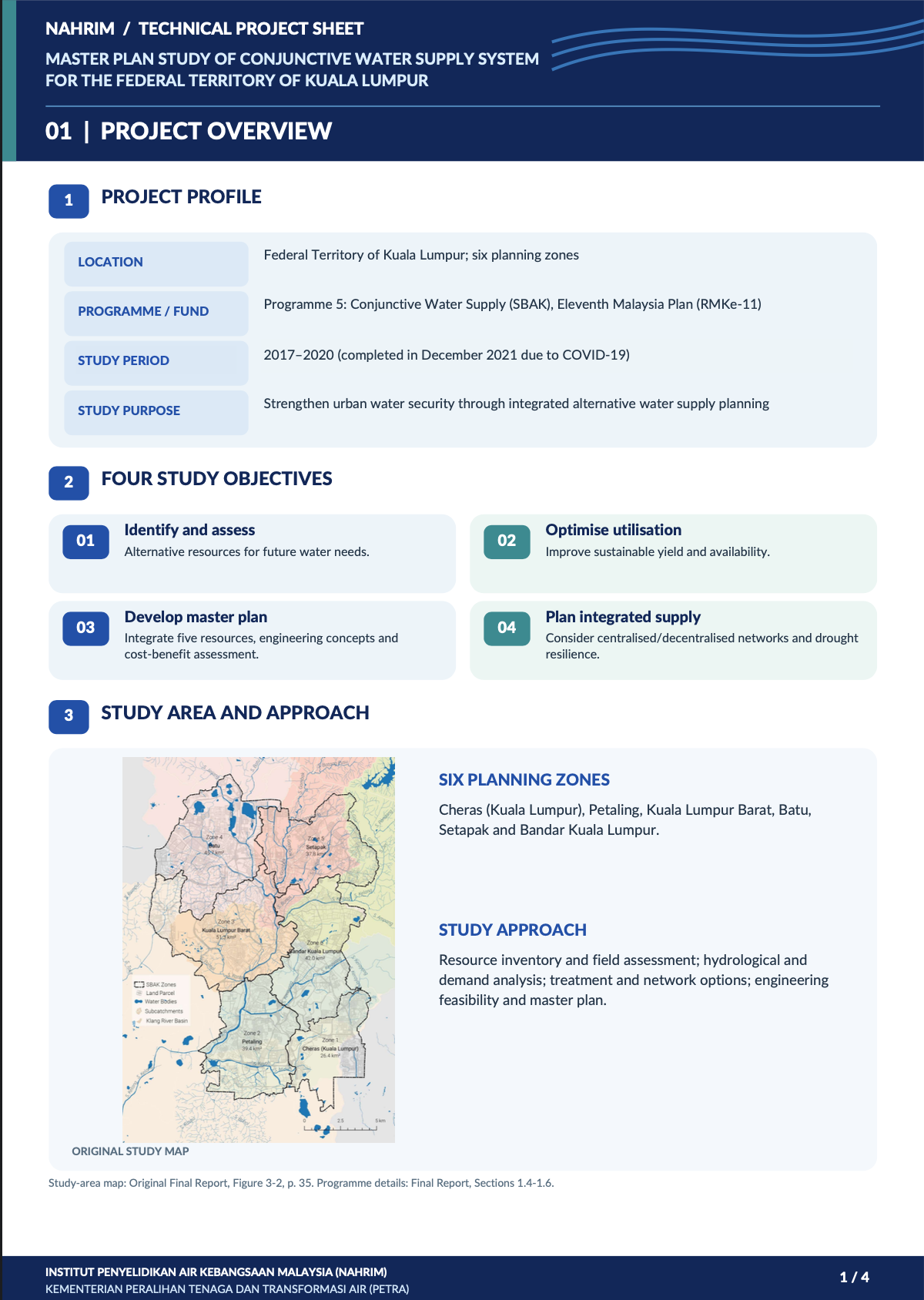
The Master Plan Study of Conjunctive Water Supply System for the Federal Territory of Kuala Lumpur was undertaken to assess the potential of alternative water resources and develop an integrated water supply master plan to strengthen urban water security and resilience to drought and climate variability. The study evaluated five alternative water resources comprising rainwater harvesting, stormwater, groundwater, treated wastewater and river low flow across six planning zones in Kuala Lumpur. Through resource assessments, field investigations, modelling and engineering feasibility evaluations, the study identified an initial water resource potential of 1,018.78 million litres per day (MLD), with a recommended practical potential of 842.22 MLD. This comprises 533.09 MLD for potential potable supply after treatment, 297.54 MLD for industrial reuse and 11.59 MLD for supplementary domestic rainwater use. The study subsequently developed a conjunctive water supply master plan incorporating six proposed development options, including the Batu Pond alternative water supply pilot and potential water transfers to existing treatment facilities. The findings demonstrate the potential of a decentralised and hybrid water supply approach to diversify water resources, improve supply reliability and support sustainable urban water management. The study provides a strategic planning framework for the phased development of alternative water resources to enhance Kuala Lumpur's long-term water security.
Authors
Abstract
The Master Plan Study of Conjunctive Water Supply System for the Federal Territory of Kuala Lumpur was undertaken to assess the potential of alternative water resources and develop an integrated water supply master plan to strengthen urban water security and resilience to drought and climate variability. The study evaluated five alternative water resources comprising rainwater harvesting, stormwater, groundwater, treated wastewater and river low flow across six planning zones in Kuala Lumpur. Through resource assessments, field investigations, modelling and engineering feasibility evaluations, the study identified an initial water resource potential of 1,018.78 million litres per day (MLD), with a recommended practical potential of 842.22 MLD. This comprises 533.09 MLD for potential potable supply after treatment, 297.54 MLD for industrial reuse and 11.59 MLD for supplementary domestic rainwater use. The study subsequently developed a conjunctive water supply master plan incorporating six proposed development options, including the Batu Pond alternative water supply pilot and potential water transfers to existing treatment facilities. The findings demonstrate the potential of a decentralised and hybrid water supply approach to diversify water resources, improve supply reliability and support sustainable urban water management. The study provides a strategic planning framework for the phased development of alternative water resources to enhance Kuala Lumpur's long-term water security.
Citation
IR. MARINI MOHAMAD IDERIS . 2022. MASTER PLAN STUDY OF CONJUNCTIVE WATER SUPPLY SYSTEM FOR THE FEDERAL TERRITORY OF KUALA LUMPUR - PROJECT SHEET. Digital NAHRIM Publication Repository.